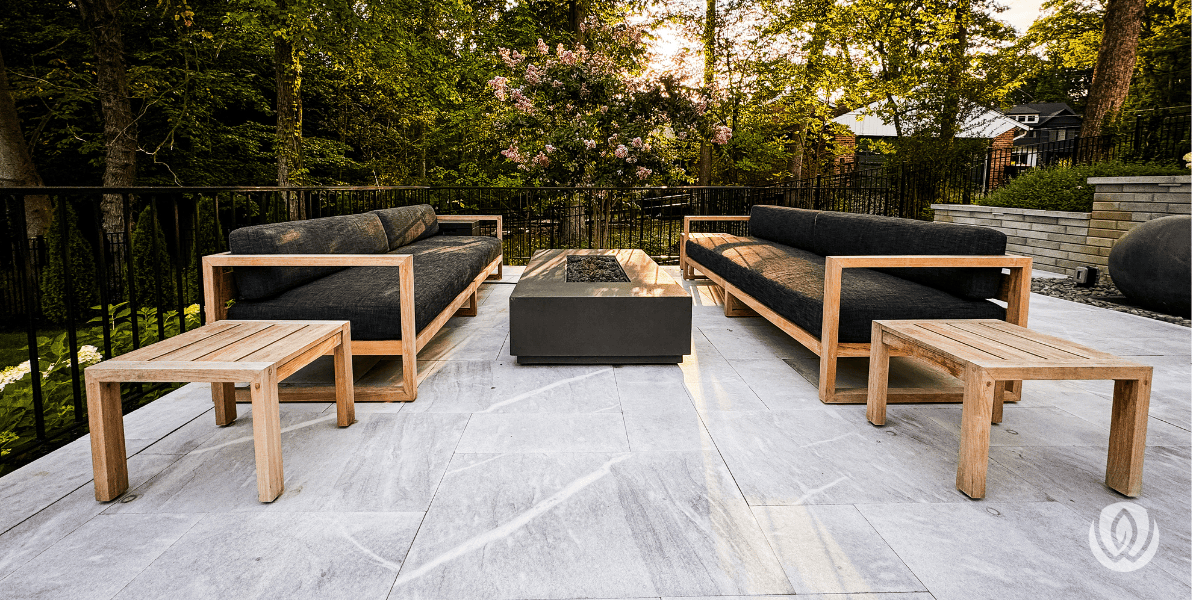
A beautiful patio can completely change the way you experience your backyard.
It can turn a regular lawn into an outdoor dining room, a cozy place to gather around the fire or a swanky poolside lounge. But creating a patio that remains both beautiful and functional for many years to come requires more than just picking out colors and patterns. It’s what’s beneath your feet that really matters.
Pavers are a popular choice in luxury patio design, but not all pavers “behave” the same. Various styles perform differently in extenuating circumstances, like direct sunlight, water, or in high-traffic areas. Some require more maintenance than others, some retain more heat and some provide better traction when wet.
These differences may not be obvious when you're looking at samples in a showroom, but they become very noticeable once you're actually living with the space.
So, are pavers a good choice for building your dream patio? In many cases, yes. Pavers offer an impressive combination of durability, design flexibility, repairability, and long-term performance.
But choosing the right type of paver requires looking beyond aesthetics.

One of the key features of patio pavers is that they’re single, smaller units installed together to create a larger surface. They can be made from materials including concrete, natural stone, and brick, and they come in a wide variety of colors, sizes, textures, and patterns.
When building your patio using individual pavers, one of the biggest advantages is flexibility.
If one becomes damaged or stained, it can often be removed and replaced without rebuilding the entire patio. That can make long-term maintenance more manageable than it would be with some monolithic surfaces.
Pavers also offer considerable design freedom.
You can combine different sizes, create borders and inlays, or use large-format pavers for a cleaner, more contemporary appearance.
But the real question isn't simply whether pavers are good for patios, it's which pavers are right for your property and how you plan to use it.
There are several common patio paver materials, and each one offers a different combination of appearance, comfort, maintenance, and durability.
Concrete pavers are one of the most versatile choices for outdoor patios.
They are manufactured in a wide range of shapes, sizes, colors, and textures, making it possible to create everything from a traditional patio to a sleek, modern outdoor living space.
Concrete pavers can also replicate the appearance of natural stone while offering more predictable sizing and a broad range of design options.
For homeowners creating a large entertaining space, pool deck, or outdoor kitchen area, concrete pavers can provide the flexibility needed to create a cohesive design.
The quality of the product matters, however. Premium architectural concrete pavers can offer a considerably different appearance and performance than inexpensive entry-level products.
Natural stone offers a different aesthetic.
Stone pavers such as bluestone, flagstone, and travertine have natural variations in color, texture, and pattern that give a patio a more organic appearance.
For luxury landscapes, natural stone can create a particularly strong connection between the patio and surrounding gardens, retaining walls, pools, and other natural elements.
Stone also ages beautifully when properly selected and installed.
The trade-off is that natural stone can require more careful material selection. Different stones have different characteristics when it comes to heat, porosity, texture, and slip resistance.
For that reason, the "look" of a stone should never be the only factor driving the decision.
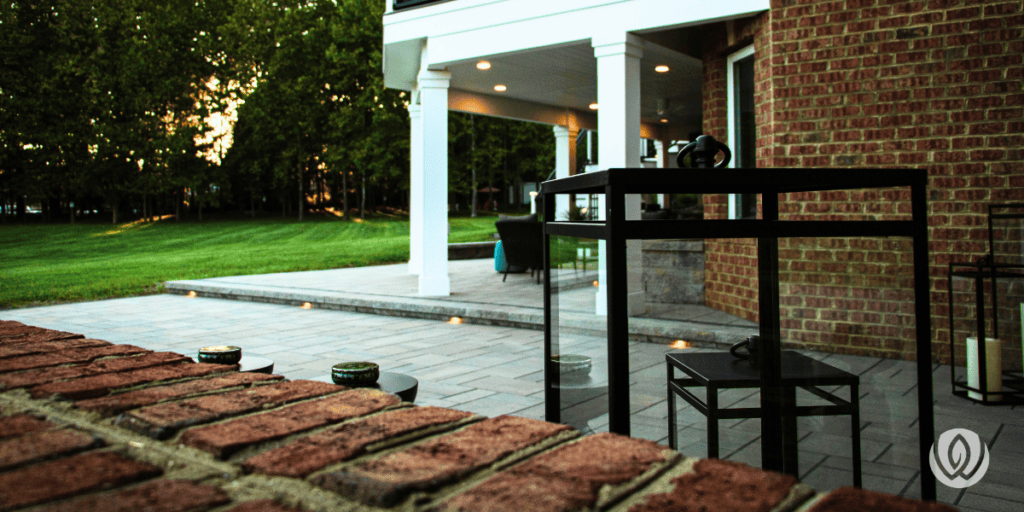
Brick has a timeless quality that works especially well with traditional architecture.
Brick pavers can create a warm, established appearance and work beautifully with classic homes, garden spaces, and traditional outdoor living designs.
Brick can also be used to create attractive patterns such as herringbone, running bond, or basketweave.
Its appearance may be the primary reason homeowners choose it, but the surrounding design should still be considered. Brick can establish a very specific architectural character, so it should complement the home rather than compete with it.
Rubber pavers are less common in high-end residential patios but can make sense in specific applications.
Their softer surface can provide additional impact absorption, which may be useful in recreational areas or spaces where comfort underfoot is a priority.
However, they're not typically the first choice for a luxury patio where the goal is to create a seamless visual connection between the home's architecture, hardscape, pool, and landscape.
As with any material, the right application matters as much as the product itself.
Once you've narrowed down the material, it's time to think about how the patio will actually perform.
The most important considerations aren't always visible in a product catalog.

If you've ever stepped barefoot onto a dark surface in the middle of summer, you know how quickly outdoor materials can become uncomfortable.
Some pavers absorb and retain more heat than others.
Color plays a role, too. Darker materials generally absorb more solar energy than lighter-colored surfaces. This becomes particularly important for patios surrounding pools.
A surface that looks beautiful in a sample can feel very different when it's exposed to several hours of direct afternoon sun.
If barefoot comfort is a priority, consider:
The goal isn't necessarily to find a material that never gets warm. It's to choose one whose performance matches how you'll use the space.
Slip resistance becomes especially important anywhere water is present.
Pool decks, outdoor showers, hot tub areas, and patios near water features can all become wet during normal use. A perfectly smooth surface may look sophisticated, but it isn't necessarily the most practical choice for a poolside environment.
Texture can provide additional traction, but excessive texture can affect barefoot comfort.
That's why water feature adjacent pavers require a particularly thoughtful balance between appearance, comfort, drainage, and slip resistance.
The best material depends on the specific application, not simply whether the product looks good next to the water.
Upfront material cost only tells part of the story.
When comparing patio pavers, think about what the surface will require five, ten, or even fifteen years from now.
Different materials may require different levels of:
As we mentioned before, one of the advantages of pavers is that individual units can often be removed and replaced if they become damaged. That can be particularly valuable in an outdoor living space where one area may experience more wear than another.
Planning for those conditions from the beginning can help you choose a material that remains practical as the space ages.
What size of pavers you choose is another important design decision.
Large patio pavers have become increasingly popular in contemporary outdoor spaces because they create fewer visible joints and can give a patio a clean, architectural appearance.
Large-format pavers can work especially well with modern homes, minimalist landscaping, and contemporary outdoor kitchens.
Smaller pavers, meanwhile, can create more visual movement and work beautifully with traditional homes, curved layouts, or intricate patterns.
Neither is inherently better, but the scale of the paver should relate to the scale of the space and the architecture surrounding it. A huge paver can feel out of place in a small, intimate garden patio, while tiny units may make a large modern terrace feel unnecessarily busy.

As we touched on previously, water features change the requirements for your patio, maybe none more so than a pool.
You're dealing with water, wet feet, barefoot traffic, direct sunlight, and frequent movement between different areas of the backyard.
That means poolside pavers should be evaluated for more than appearance.
Think about:
A beautiful pool surrounded by a disconnected patio can feel like two separate projects. Designing your pool and patio with coordinating materials creates a more cohesive outdoor environment.
An outdoor kitchen comes with an entirely different set of considerations.
This area is likely to experience more spills, grease, food debris, and foot traffic than a quiet garden patio, but that doesn't mean you need a utilitarian surface.
Instead, choose a material that can handle the realities of entertaining while still complementing the countertops, cabinetry, appliances, and surrounding landscape.
For example, a paver color or texture can be selected to complement the stone used on an outdoor kitchen island or nearby retaining wall.
The goal isn't to make every surface identical, it's to create enough visual connection that the entire outdoor kitchen feels like part of the larger design.
Fire pits and fireplaces create a natural gathering point, which means the surrounding patio receives concentrated foot traffic. The pavers around a fire feature should be selected with both comfort and practicality in mind.
You'll also want to consider the scale of the surrounding seating area. A fire pit placed on a beautiful patio but surrounded by cramped furniture won't feel luxurious.
The pavers, seating, circulation, landscaping, and fire feature should all be planned together.
This is one reason patio paver design should be considered as part of the larger outdoor living plan rather than as an isolated material decision.
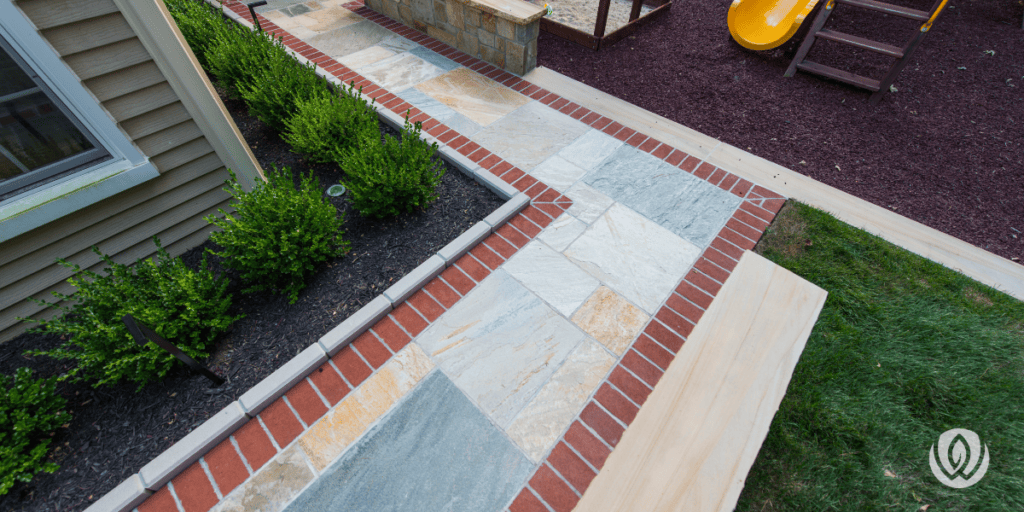
Now for the really fun part: once you've chosen the right material, then you can start thinking about the design!
The pattern you choose can dramatically change the character of the patio.
Common options include:
You can also use borders and inlays to define different areas within a larger patio.
For example, a contrasting border can frame an outdoor dining area, while an inlay can visually anchor a fire pit or seating area.
These details are especially effective in larger outdoor spaces because they provide visual structure without requiring physical walls or barriers.
And don’t forget to keep the entire space in mind. The best patio design doesn't stop at the edge of the pavers. A patio paver that looks beautiful on its own may not be the best choice if it clashes with the pool coping or makes an outdoor kitchen feel disconnected from the house.
This is where professional outdoor decking and hardscape design can make a difference. The goal is to create transitions that feel natural rather than treating each feature as a separate installation.
Another factor to keep in mind is that a patio is a long-term investment.
That's why the best material isn't necessarily the one with the lowest initial price or the one that looks most impressive in a showroom.
Think about how the material will perform through years of:
A material that costs slightly more initially may make sense if it provides the comfort, durability, and appearance you're looking for over the long term.
Likewise, a more expensive material isn't automatically better. The right choice depends on the property, the surrounding architecture, the intended use, and your priorities for maintenance and longevity.
The best patio isn't simply the one that looks beautiful on installation day. It's the one that still feels comfortable when you're walking barefoot across it ten years later.
It's easy to maintain after a summer of entertaining. It works naturally with your pool and outdoor kitchen. And most importantly, it feels like a seamless extension of your home.
At LiveWell Outdoors, we know that patio pavers are just one piece of your ideal outdoor living experience.
Our team is here to guide you every step of the way in designing an outdoor space that’s not just beautiful, but built to be enjoyed for years to come.
Schedule a call today to start designing the patio of your family’s dreams.
"*" indicates required fields