Head to any of the world's best resorts and you’ll notice a trend. Everywhere you turn, you’ll see water in motion.
A waterfall changes the entire mood of a pool before you ever even step into it. You hear it from the patio. You catch the movement from inside the house.
It can take an ordinary backyard and make it feel like somewhere you should have booked a flight to.
A pool waterfall can change the atmosphere of an entire backyard. The movement of the water catches the light, softens the world beyond the property, and gives the pool the kind of presence you expect from a private resort.
And creating ambience is just the beginning of what a waterfall can do for the way your space actually feels and functions.
The obvious answer is beauty. But a thoughtfully designed waterfall changes more than just the view.
Introduce movement to an otherwise still body of water and suddenly the eye has somewhere to go.
The style of waterfall you choose will depend on the pool itself, the style of your home, and the design of your surrounding yard. It should feel like a natural part of the landscape, not a random decorative feature chosen after the fact.
That could mean a broad sheet of water falling from a stone wall beside a contemporary pool. On a more natural property, it might be several tiers of stone spilling into a freeform pool that feels closer to a private lagoon.
A waterfall can contribute to your pool’s circulation system.
Your pump and filtration system still do the serious work, but moving water can help push water through areas where circulation is weaker.
There is also something luxurious about that constant motion. A pool that moves and catches the light simply feels more alive.
Flowing water can help soften sounds beyond your property line, creating a more private atmosphere.. Imagine peacefu l mornings and realaxing dinners outside in your own private oasis.
If your idea of luxury includes making the rest of the world feel slightly farther away, this is where a waterfall can really come in handy.
The most impressive waterfall is not necessarily the largest one.
When designing a waterfall feature for your backyard pool, scale, architecture, sound, and placement matter more than sheer size. A massive waterfall positioned beside a sprawling freeform pool could overwhelm a restrained design.
The overall aesthetic design of your yard will point you in the ideal direction of the waterfall of your dreams.
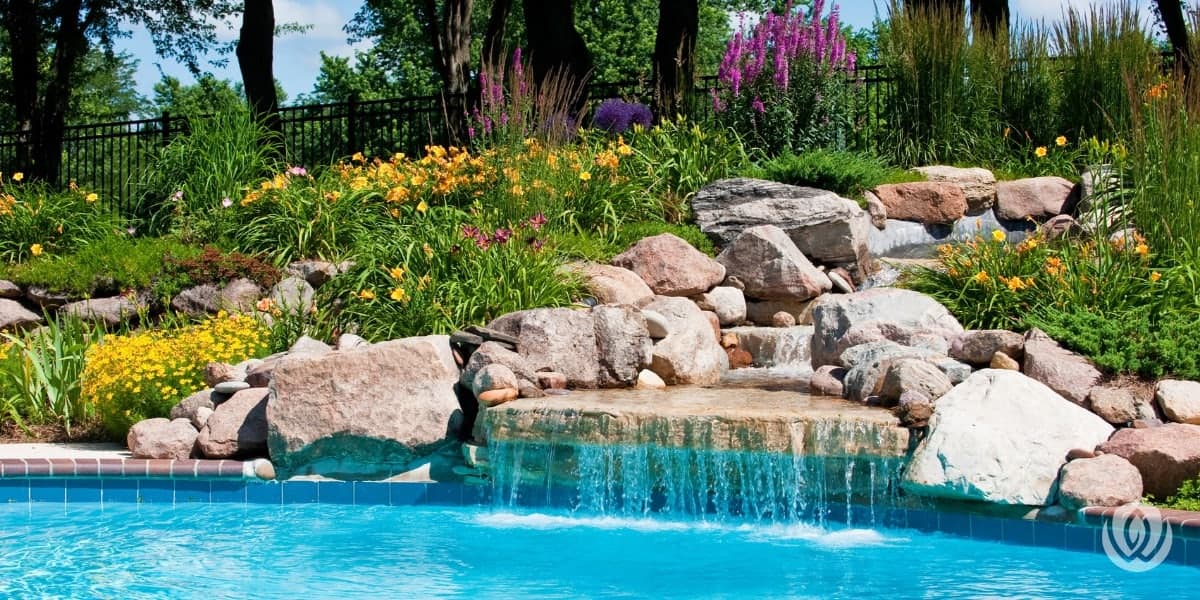
Natural stone and high-quality architectural rock can create layered falls that make a freeform pool feel less constructed. The water can tumble over several levels, disappear behind plantings, or become part of a larger formation with a grotto or slide.
These designs work particularly well when the surrounding landscaping already has an organic character. Large stone masses, mature planting, and irregular pool shapes can make the feature feel as though the water was there first and the house simply happened to arrive later.
A more modern house often wants something cleaner.
A sheer descent sends a smooth sheet of water from a raised wall or architectural element into the pool below. The effect is controlled, geometric, and especially striking after dark when light catches the water.
While one can be enough, several placed along a feature wall can turn the entire side of the pool into an architectural moment.
This style also tends to work well when homeowners want to add a waterfall to an existing pool. This style can sometimes be incorporated into a new wall or surrounding hardscape withouthaving to create a massive rock structure.
This design is what often springs to ming when one hears the word, “waterfall”. Swim through a curtain of water and you enter a tucked-away area that can include seating and underwater lighting.
A grotto also asks more of the property. It needs room, careful engineering, and enough visual scale to keep it from feeling forced. This is usually a decision best made while the pool itself is being designed, when the structure and surrounding landscape can be planned around it.
On a large property, though, it can give the pool the kind of theatrical quality you normally expect to find at a destination resort.
If the backyard needs a little more play, a slide can be incorporated into the same rock formation as the waterfall.
Done well, you do not see "slide on one side, waterfall on the other." Instead, you’ll see one sculptural feature with the slide disappearing naturally through the stone.
This combination is particularly suited to freeform pools and larger family properties. The waterfall gives adults the resort atmosphere. The slide gives everyone a very good reason to stay in the pool until dinner.
An elevated spa offers one of the most elegant opportunities for moving water.
Positioned above the pool, the spa can spill into the water below through one broad opening or several smaller ones. Depending on the materials and height, the result can range from understated to dramatic.
Because the spa elevation and plumbing are part of the pool design, this effect makes the most sense when the pool and spa are planned together.
It is a good example of why thinking about the entire outdoor living space early pays off. One feature can serve the spa, animate the pool, and create the sound of moving water without asking for another structure.
A rain curtain creates droplets rather than a solid sheet of water.
The effect is lighter and more delicate than a traditional waterfall, which makes it particularly attractive in contemporary spaces where a massive naturalistic feature would feel out of character.
A rain curtain can fall from a pavilion, pergola, feature wall, or another overhead structure near the pool.
During the day, it adds movement without dominating the view. At night, lighting can turn it into something far more dramatic. like PebbleTec’s fire and water bowls for their dramatic effect.
Often, the answer is yes.
This is where design really matters since the new feature has to make sense with a pool that already has its proportions, plumbing, coping, deck, and surrounding landscape in place.
Some waterfall styles are naturally easier to introduce during a pool remodel than others.
Sheer descents and smaller cascades can often be incorporated into a new raised wall or hardscape element at the edge of the pool. If you already have an elevated spa, there may also be opportunities to rethink the spillway.
Large rock waterfalls and grottos require a more involved conversation. They may call for changes to the coping, surrounding concrete, plumbing, and structural support.
But just because it’s possible to add a waterfall doesn’t mean it’s easy
If a massive grotto would look awkward beside a restrained geometric pool, a simpler wall with falling water may produce a far more expensive-looking result.
That is the advantage of starting with the property rather than starting with an inspiration picture saved to your phone.
For an existing pool, the process begins with the site.
A designer needs to understand the pool structure, plumbing, available deck space, surrounding elevations, and how people already move through the backyard. From there, the question becomes which type of waterfall makes sense and what needs to change in order to support it.
The pump and plumbing may need modifications. A raised wall may need to be built. Existing coping or hardscape may need to be opened and restored.
And that’s just the work people don’t see.
Stone, plants, lighting, and the surrounding patio determine whether the finished waterfall feels integrated or retrofitted.
For simpler waterfall additions, construction itself may be relatively contained. More elaborate rock formations and structural modifications naturally involve a larger scope.
Permit requirements also depend on the jurisdiction and the work involved, so the timeline should be established around the specific property rather than an arbitrary number.
There is no single price for a custom waterfall.
A streamlined sheer descent built into a wall is an entirely different project from a multi-level stone formation with a grotto, integrated lighting, new plumbing, and surrounding landscaping.
The final investment depends on the waterfall style, scale, the existing pool, site access, plumbing requirements, structural work, materials, and the rest of the surrounding design.
This is where designing the whole scene at once can be helpful.
If you already know you want lighting beneath the waterfall, planting around the stone, and automation that lets you control the feature without walking out to the equipment pad, it makes far more sense to plan those elements together.
Few things spoil a resort-like vibe faster than realizing the beautiful new waterfall now needs another round of construction around it.
The most successful pool waterfalls rarely feel like accessories.
At LiveWell Outdoors, we understand that the larger picture is where pool planning truly begins.
Related Reading:
Whether you’re thinking of refreshing your existing pool or dreaming of designing a brand new private backyard retreat, we’re here to guide you from the first sketch to the last tile.
Schedule a call today to design the backyard pool waterfall of your dreams.
"*" indicates required fields